69 dead in Spain train crash, the second fatal rail disaster this year
A collision near Urda on the Madrid-Seville line has intensified scrutiny of Spain’s rail safety system ahead of a November election.
By Karan Meyer ·
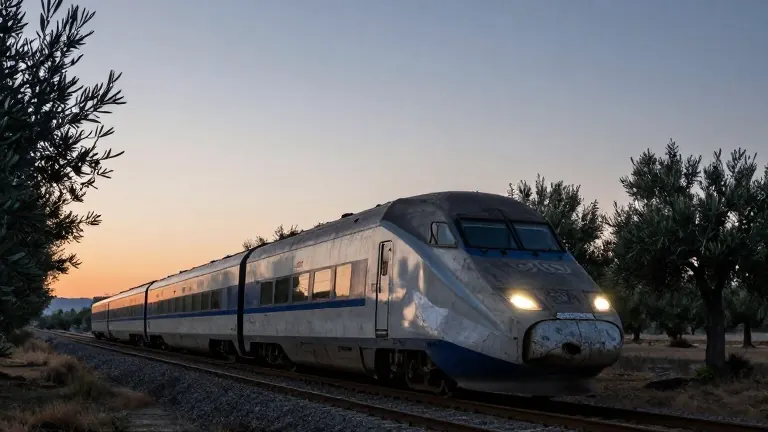
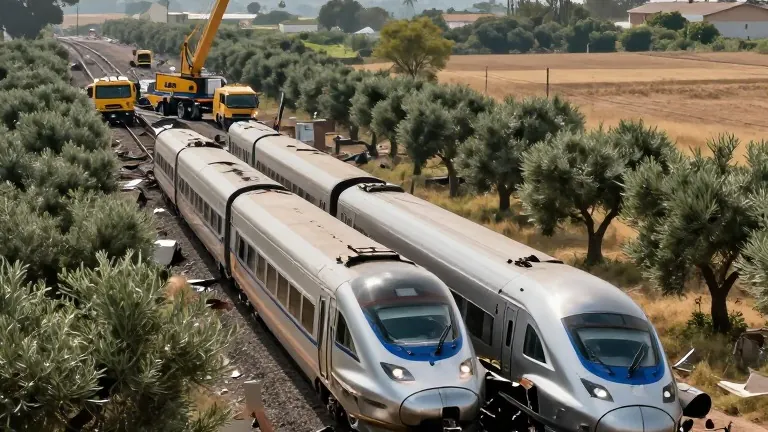
Sixty-nine people died when one high-speed train struck another from behind in central Spain, marking the second fatal rail disaster in the country this year. The crash occurred Wednesday morning near the village of Urda, on a stretch of track lined with olive groves. Search teams using sniffer dogs continued looking for victims on Thursday, a day after the impact. Cranes moved the wreckage as police and soldiers examined the debris scattered down a gravel slope, where at least three carriages were thrown by the force of the collision.
Emiliano García-Page, the regional leader of Castilla La Mancha, confirmed the death toll of 69 after one more body was found overnight. He stated that 50 people remained hospitalized. Officials are working with family members to identify the victims. Spain’s King Felipe VI visited injured passengers at a hospital in Toledo and said the country must adopt measures to prevent such a tragedy from recurring. The government declared three days of mourning starting Thursday, and a minute of silence was held at noon for lawmakers and rail workers in Madrid.
The Spanish high-speed rail network is the second largest in the world, after China’s. It had not seen a deadly crash since entering service more than 30 years ago until this year. In January, 46 people died when a train derailed and hit another traveling in the opposite direction in southern Spain. Both incidents this year occurred on the same line connecting Madrid and Seville, which opened in 1992. Each crash involved a train operated by state-owned RENFE and another run by private company IRYO. Spain opened its high-speed rail market to private operators in 2021, and IRYO began service the following year.
Prime Minister Pedro Sánchez pledged an investigation and safety improvements to restore confidence in a system that carried 45 million travelers last year. He visited the crash site twice and called the event a tragedy. Sánchez said it was not acceptable for Spain to endure two high-speed train accidents in a single year. He had called for early elections on November 29, hoping to capitalize on voter discontent over housing costs. Now, he faces questions about rail safety, along with existing criticism of his migration policies and corruption allegations against his party.
Transport Minister Óscar Puente stated on Wednesday that human error caused the crash. He described an order from the central command center as inexplicable. At 8:30 a.m., a computer malfunction caused the security system to fail, stopping all trains on that section of track. The IRYO train was stationary, with the RENFE train 25 kilometers behind. Minutes later, the command center instructed the RENFE train to proceed without speed restrictions. It collided with the stopped IRYO train at 8:53 a.m. Puente noted that a stop signal was still active, meaning the train should not have moved, or should have moved at reduced speed.
Train workers held a planned strike on Thursday to demand safety upgrades that unions say were promised after the January crash. Union leaders questioned the minister’s focus on a single controller and criticized the release of control room audio to the media. Pepa Páez of the CCOO union argued that the focus should be on systemic improvements so that human error does not lead to such outcomes. A judge declared the crash site an investigation zone. Thousands of travelers were left seeking alternative transport as the Madrid-Seville high-speed line remained shut down.
Alberto Núñez Feijóo, the leader of the conservative Popular Party, demanded a full investigation. Alejandro Quiroga, a political science professor at Complutense University, said it was too early to know if the crash would change many voters’ minds. He noted that Spaniards generally dislike politicians using tragedies for political gain. The next scheduled event is the national election on November 29.
Source: WSVN