One hour: The time window that cost a veteran reporter her life
Amal Khalil died roughly sixty minutes after her rescue, a delay that human rights groups cite as evidence of a breach of protocol during the April 22 strike.
By Karan Meyer ·
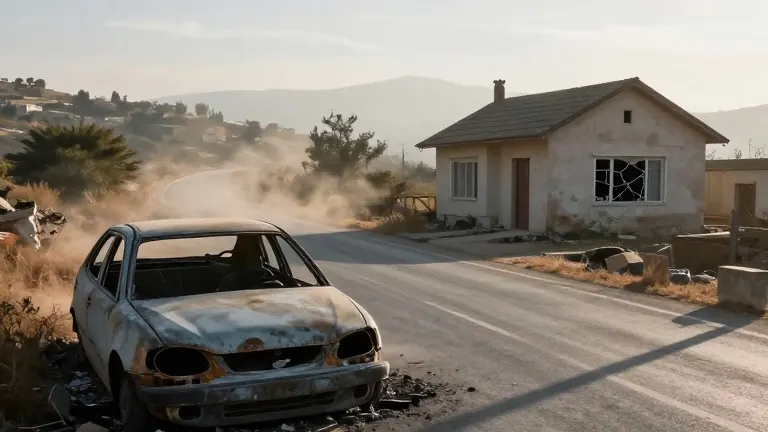
A truce in southern Lebanon was supposed to allow civilians to return to their villages and assess the damage. Instead, for two journalists and two men in a car ahead of them, the pause in fighting became a deadly trap.
On the afternoon of April 22, 2026, Zeinab Faraj, 21, and Amal Khalil, 42, drove toward the village of al-Tiri to document the aftermath of airstrikes. Faraj, a photojournalist finishing her degree in radio and TV, had joined Khalil, a newspaper reporter, after the latter saw her social media work. They were following a vehicle carrying Ali Nabil Bazzi, 27, a municipal official, and Mohammed Hourani, 37, a friend of the mayor. The group had met earlier at Tebnine governmental hospital, a temporary safe haven for locals planning their movements.
A missile struck the leading car, setting it on fire. Faraj heard Khalil scream before seeing the flames. She approached the vehicle to check on Bazzi, while Khalil repeated, "Oh God, they're gone." Faraj observed that the bodies inside were torn apart. Drones then appeared, flying low and close to the two women's position. They called emergency services, which repeatedly assured them help was on the way. Faraj described these assurances as an anaesthetic that briefly numbed the reality of their situation.
A paramedic on the phone advised them to drive back up the road because ambulances were being prevented from approaching. As the women tried to enter their vehicle, it was struck by a second missile. The impact threw them backward, with Khalil wrapping her arms around Faraj. They took shelter in a nearby house, where Khalil sustained visible injuries to her face, hand, and leg. Faraj sent a final message to her sister, reading, "There's no hope left. Forgive me," before her phone battery died.
Inside the bathroom, Faraj crawled to a position to watch the road. A drone descended sharply toward her, causing her to feel a sudden terror. She retreated inside, feeling detached and alone. A third missile then fell nearby. Faraj lost consciousness and woke up trapped under rubble, unable to breathe. A paramedic reached the scene and held her shoulders while a second worker cleared the debris. As they were pulled free, a stun grenade dropped from a drone. During the ambulance ride, Faraj mistook the vehicle's sound for incoming aircraft.
At the hospital, nurses eventually fell silent when Faraj asked about Khalil. Khalil is believed to have died approximately one hour before paramedics were permitted to return to the area for the rescue. The Israeli military stated the strike targeted saboteurs violating the ceasefire. Human rights groups labeled the incident a war crime. A week prior, an Israeli military spokesperson had shared a video of Khalil, labeling it terrorist media. Khalil had also received death threats from Israeli numbers.
Faraj is now preparing to return to university, though she still has difficulty walking. Visible injuries mark her hand and face, affecting the movement of one eyebrow. She wakes at night screaming, fearing strikes, and remains haunted by the image of Hourani lying on the ground with his eyes open.
The delay in rescue remains the central point of contention regarding the handling of the two women during the ceasefire.
Source: The Guardian