Commuters Face 36% Jump in Crashes After Clock Change
Data from Connecticut shows a sharp rise in evening collisions following the end of daylight saving time, driven by earlier darkness and disrupted sleep patterns.
By Chloe Phillips ·
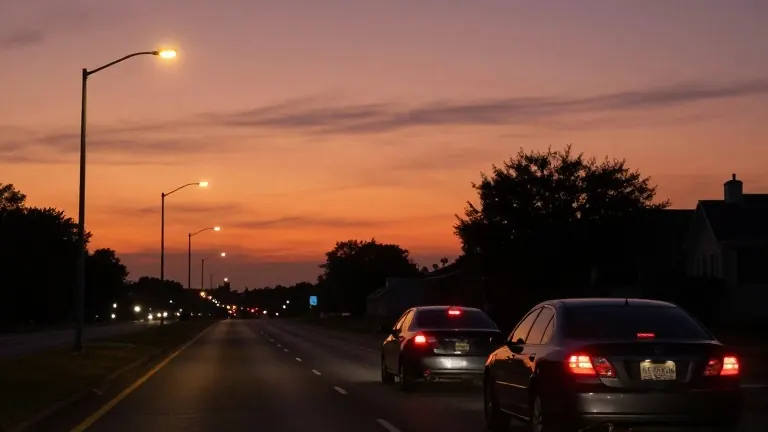
Drivers in the Northeast will face a higher risk of collision in the hours after the clocks roll back this Sunday. The shift means the 5:00 to 6:00 p.m. commute will occur in darker conditions, a period that data shows is becoming increasingly hazardous for motorists.
The change in light levels is the primary factor, but it is compounded by biological shifts in the body. AAA Northeast analyzed state crash data to measure the impact of this annual transition on road safety. Their findings indicate a steep increase in accidents during the peak evening hour immediately after the time change.
In Connecticut, the shift has measurable financial and safety implications. According to the Connecticut Crash Data Repository, crashes during the 5:00 p.m. hour rose by 36% in November compared to October. Between 2020 and 2025, state records show 4,134 crashes in that specific hour in October, which jumped to 5,615 in November.
This spike is not unique to the state. The regional analysis reveals that the sudden decrease in visibility as evening darkness arrives earlier is a leading cause of the increase. While the time change technically gives drivers an extra hour of sleep, the disruption to circadian rhythms can last for days or even weeks for some individuals.
Jillian Young, director of public relations for AAA Northeast, noted that the combination of earlier sunsets and altered sleep schedules creates a challenging environment for drivers. She advised that commuters anticipate that other drivers are also adjusting to the reduced visibility. "Drivers can help make the evening commute safer by getting enough rest, staying extra vigilant as rush hour becomes darker," Young said.
Research suggests that many drivers underestimate their own fatigue levels. In a simulated nighttime driving experiment conducted by the AAA Foundation for Traffic Safety, 75% of participants who rated themselves as having low drowsiness were actually moderately or highly drowsy. This disconnect between perception and reality increases the likelihood of errors during the dark commute.
To mitigate these risks, AAA Northeast recommends that drivers inspect their vehicle lights for yellowing or clouding, a process that can occur in as few as three years. Drivers should also verify that wiper blades are in good condition and that windshields are free of streaks that could scatter light at night.
On the road, the recommendation is to increase following distance to four seconds or more and to reduce speed when turning at intersections. The organization suggests slowing to 5 mph during turns and avoiding high beams that could blind oncoming traffic. Drivers should also be aware of sun glare, which may hit earlier in the day due to the changed angle of the sun.
The time change is scheduled for this Sunday, when clocks will be set back by one hour. This will result in the 5:00 p.m. hour being significantly darker than in previous weeks. The increase in crashes observed in November data suggests that this darker window will be a focal point for traffic safety in the coming months.
AAA Northeast serves more than 6.9 million members across Rhode Island, Massachusetts, Connecticut, New Jersey, New Hampshire, and New York. The organization provides travel, insurance, and auto-related services to its local membership base.
Source: Greenwich Free Press
More Business · Unethical Practices · Report a business · Got a Story?